I first began thinking seriously about the relationship between confidence and creativity while teaching science in a London secondary school serving a highly disadvantaged community.
Sixty different languages were spoken there, and many of the students were dealing with poverty, instability and difficult circumstances outside the classroom.
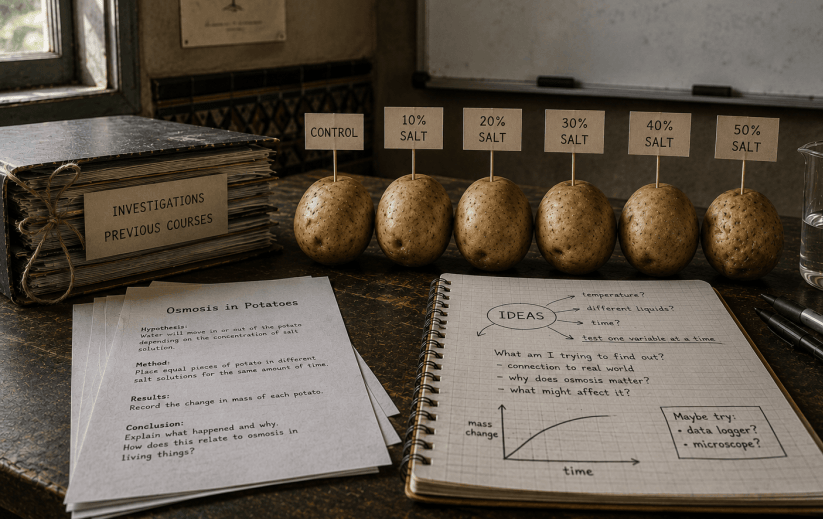
There were plenty of problems to solve, but one of the most persistent was investigative coursework. To pass the English exam system, students had to investigate a scientific question and write a report on their hypothesis, the method they chose, and the conclusions they reached. Even the most motivated students struggled to understand what was being asked of them. They could not copy from a book or memorise the answers, so many simply did not know how to begin.
What confused me most was that the students who struggled were often the most outwardly confident.
They believed in themselves and were positive about their abilities. Many of them would have scored highly on established measures of self-esteem. Yet when they were asked to come up with ideas of their own, that confidence did not seem to help.
This became impossible to ignore in my first year of teaching, when five pupils handed in exactly the same investigation, word for word. They had stolen my folder of previous years’ examples and copied it entirely. It took confidence, planning and considerable initiative to find and steal the Osmosis in Potatoes papers from a locked classroom, but not one of them had thought to change even a sentence to make the paper sound like their own.
At the time, I could not understand it. If they could organise themselves to do that, why could they not think independently in science?
Confidence didn’t explain what I was seeing
In education classes, we are taught that confidence matters. The reasoning is straightforward: if students believe in themselves, they should be more willing to take risks, and persist when something becomes difficult. There are entire frameworks built around self-esteem and self-efficacy, and on the surface the relationship seems obvious. If you believe you can do something, you are more likely to try.
But what I was seeing in my classroom did not fit that explanation.
Some of my most confident students were producing the least original work. When it came to generating ideas of their own, they became confused or overwhelmed, while other students who were quieter and less assured could sometimes take an idea and run with it.
Research into creativity also complicates the assumption that confidence is the cause of creative performance. General self-esteem does not reliably predict the quality of creative output, and even creative self-efficacy, the belief that we can produce creative outcomes, appears to influence whether people engage in creative behaviour more consistently than it predicts what they actually make.
The difference was in the structure
The problem became clearer after I visited another school in the same London borough. On paper, the students were remarkably similar. They came from the same area, had comparable backgrounds and faced many of the same external challenges. Yet the atmosphere in the school was completely different, and students were far more successful in the same kind of investigative coursework.
The difference was not the children.
My students were not simply less able, less motivated or less confident. They had experienced very different conditions for independent thinking and creative work. When I asked them to create the structure of a task for themselves, I was asking them to draw on a process that many had had very little opportunity to practise.
At the time, I did not have language for this. I only knew that something important was missing, and that I was failing to provide it.
Years later, working with artists, technologists, and university students, I began to recognise the same pattern in very different settings. People could be highly capable within an established structure and still struggle when they had to decide what the structure should be. Others had accumulated enough experience of uncertain work that they could find a starting point, test something incomplete, respond to what happened and keep moving.
This is one of the observations that eventually led me to Creative Privilege.
Creative Privilege is not a personality trait, and it is not simply confidence or belief in yourself. It is access to the structures under which creative work can happen reliably: the processes, environments, expectations and other people that allow an uncertain idea to develop into something real. When those structures are present, people have repeated opportunities to start, test, revise and continue. When they are absent, even highly capable people can hesitate, overthink or stop altogether.
Confidence may be an outcome, not a cause
This changes how I think about creative confidence itself.
We often look at people who produce work consistently and assume that their confidence allowed them to begin. Sometimes the relationship may run in the opposite direction. Repeated experience of having an idea, acting on it and producing an outcome gives us evidence that we can do it again. What looks later like an unusually strong belief in one’s own creativity may partly be the accumulated result of having had access to the structures that allowed creative work to succeed.
That distinction matters because telling someone to “be more confident” does not provide those structures. Neither does telling a student, employee or team to “be creative”.
A more useful question may be:
What experience have they had of turning an uncertain idea into something real, and what structures made that experience possible?
This is one of the questions behind Creative Privilege, my developing framework for understanding unequal access to the conditions that allow us to turn ideas into reality.
 Creative Privilege